


Almost every acne client who walks into Solea says the same sentence in the first five minutes: I have all these scars from my acne.
Ninety percent of the time, they don't. They have post-acne marks — flat, discoloured spots left behind after a breakout heals. That distinction sounds like semantics, but it changes everything. Because post-acne marks are one of the most treatable skin concerns we work with. And true acne scars are one of the least — at least with products.
If you're spending money on brightening serums and getting nowhere, this is often why. You're treating the wrong thing.
The three things people call "scars"
Post-inflammatory hyperpigmentation (PIH) is the brown, tan, or dark mark left behind after a pimple heals. It's not damage — it's pigment. Your melanocytes, the cells that make melanin, react to the inflammation of a breakout by producing extra pigment in that spot. It sits in the skin and gradually fades on its own over months. PIH is most common in medium-to-darker skin tones.
Post-inflammatory erythema (PIE) is the pink or red mark left behind. It isn't pigment. It's dilated capillaries — tiny blood vessels near the surface that dilated during the inflammation and haven't fully constricted again. PIE is most common in lighter skin tones.
True acne scarring is a change in the texture of the skin itself — an indentation (rolling, boxcar, or ice-pick), or occasionally a raised area (hypertrophic). The skin surface is no longer flat. That's the distinction. A mark that is smooth to the touch is not a scar. A mark you can feel with your fingertip probably is.
Run your fingertip lightly across the mark. If it's flat, you're dealing with PIH or PIE. If there's a divot, texture change, or raised area, it's scarring.
What actually works for each
For PIH — the brown marks:
- Daily SPF. Non-negotiable. UV darkens PIH faster than almost anything, and skipping sunscreen is why so many people find these marks "won't budge."
- Vitamin C in the morning — an antioxidant and a tyrosinase inhibitor that slows fresh pigment production.
- Niacinamide (2–5%) — works on a different pigment pathway than vitamin C, so you can stack them.
- Azelaic acid (10–20%) — one of the true multitaskers, especially for anyone with acne and pigmentation.
- Retinoids at night — the single best long-term investment. They speed cell turnover so pigmented cells cycle off the surface faster.
- Chemical exfoliation with an AHA like glycolic or mandelic acid, once or twice a week.
- Realistic timeline: 8 to 12 weeks minimum for meaningful fading. Six months to a year for stubborn cases.
For PIE — the pink and red marks:
Topical products help less here, honestly. Vascular lasers and IPL — the treatments that target blood vessels directly — are the gold standard. Niacinamide, centella asiatica, and consistent sun protection support the process, but PIE genuinely responds better to time and in-clinic vascular treatments than to serums.
For true scarring:
This is where honesty matters most. Creams do not resurface indented skin. What does:
- Microneedling, a series of sessions
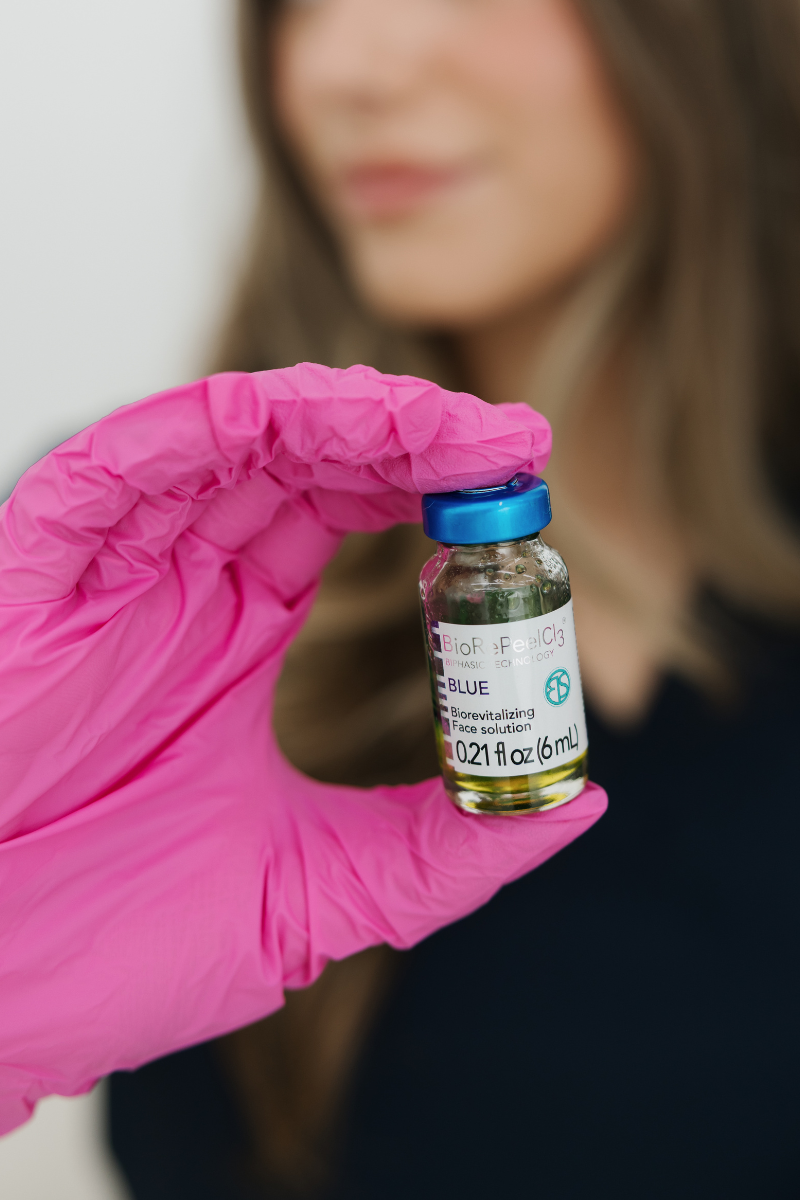
- BioRePeel and other advanced chemical peels
- In-office lasers (fractional, resurfacing)
- Dermatologist-provided options like TCA CROSS, subcision, or filler for deeper scars
We would rather tell you the truth up front than watch you spend six months on a serum that was never going to change your skin's texture.
The mistake we see most often
The most common misstep isn't picking the wrong product — it's under-treating one concern and over-treating another. Someone with PIH aggressively exfoliates hoping to "peel off" the marks, and instead creates more inflammation, which triggers more PIH. Someone with PIE doubles down on brightening serums that were never meant to constrict blood vessels. Someone with true scarring buys the entire brightening range and wonders why nothing changed the texture.
Match the treatment to the mark. It's the single most important thing you can do.
Where BioRePeel fits in
For most of our clients dealing with post-acne marks, we recommend a treatment series alongside a smart homecare routine — because the two together consistently outperform either one alone.
BioRePeel is one of our favourite tools for PIH. It works on both cell turnover and pigment fading, with almost no downtime — you can come in on a Thursday and be photograph-ready by Saturday. For deeper concerns or textural scarring, we build a plan that layers in microneedling or refers you up to a dermatologist for advanced options where that's the right call.
Set your own expectations first
If you're going to remember one thing from this article, remember this: post-acne marks take months to fade properly, and they fade twice as fast when you protect them from the sun. Every day you skip SPF is a day you undo the last week of progress.
The good news is that most of what you're looking at right now — the marks that make you self-conscious in bathroom lighting — will genuinely fade with the right plan. It just takes longer than any Instagram video is going to tell you.
If you're not sure whether what you see is PIH, PIE, or scarring, come in for a consultation. We'll assess your skin in person, tell you honestly what will and won't respond to treatment, and build you a plan that matches the marks you actually have.

Not sure where to start?
Book a consultation and we'll assess your skin in person and build a plan around what it actually needs.



0 Comments